
Top Reasons to Use Augmented Reality for Furniture in 2026
Choosing furniture online sounds convenient—until you realize the couch you ordered is too large, the color clashes with your flooring, or it simply doesn’t look right in your space. For many shoppers, that disconnect between expectation and reality turns into frustration, returns, and lost trust.
For furniture brands & retailers
How Immersive Spatial Tech Is Transforming Furniture E-Commerce
Choosing furniture online sounds convenient—until you realize the couch you ordered is too large, the color clashes with your flooring, or it simply doesn’t look right in your space. For many shoppers, that disconnect between expectation and reality turns into frustration, returns, and lost trust.
For furniture brands, the consequences are even bigger: rising return rates, abandoned carts, and a growing demand for immersive, digital-first shopping experiences.
Let’s break down why AR has become a game-changer for the furniture industry and how your brand can use it to grow faster and smarter.
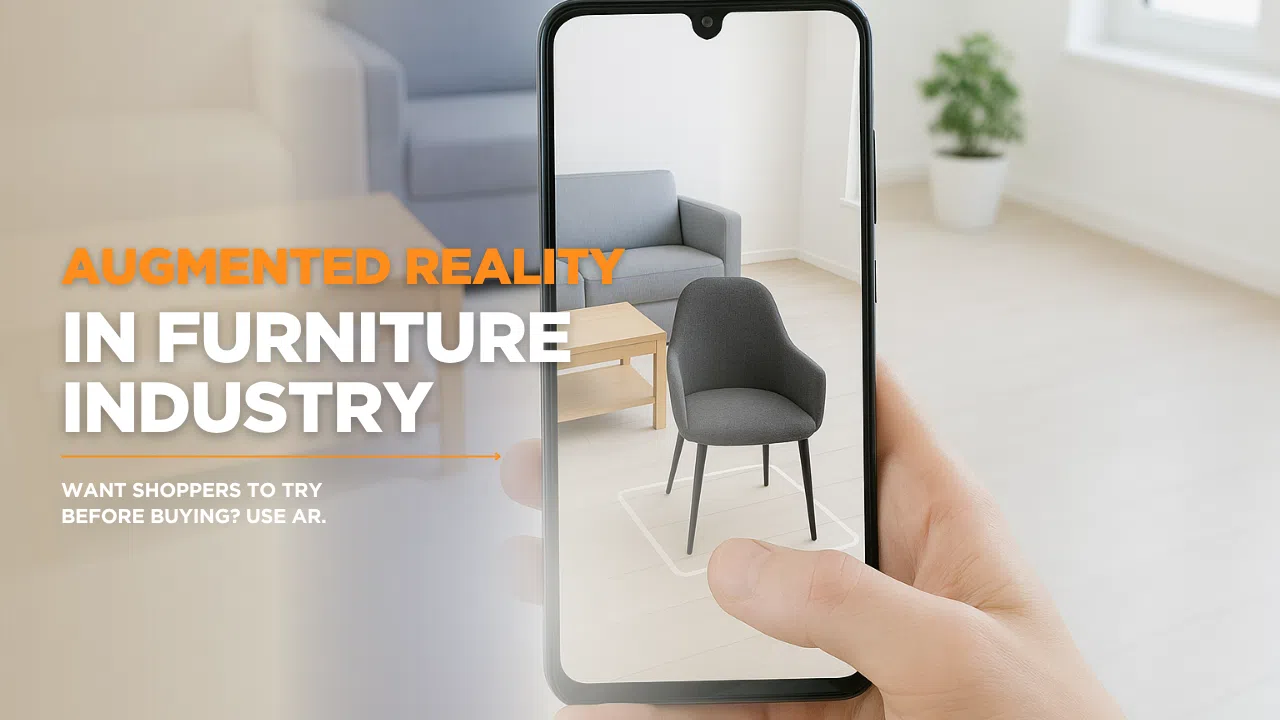
AR is no longer a futuristic novelty. It’s now a must-have feature for modern furniture retailers. Whether you’re selling sofas, shelving units, or dining tables, AR allows customers to see what products look like in their actual space—scaled accurately, in real time.
Major players like IKEA, Wayfair, and Amazon are setting the tone. The reason is simple: AR works. It builds confidence, reduces returns, and offers a better experience than static photos or guesswork dimensions ever could. If you want to build similar experiences, start by exploring our 3D furniture rendering services tailored for AR integration.
Visualize Furniture in Real Spaces — Instantly and Accurately
Already seen how AR works in eCommerce? If not, try it now — place this chair in your own space and see the experience firsthand.
At the core of AR’s value is visualization. Instead of asking your customer to imagine how a chair might fit into their corner nook, AR lets them see it live—through their smartphone camera, exactly where it would go.
This solves the age-old uncertainty of “Will it fit? Will it match? Will it look right?”
No tape measures. No second-guessing. Just clarity.
Live Spatial Placement
Customers project photorealistic 3D models directly into their living rooms, bedrooms, or offices with true spatial depth and real-time room perspective.
True Millimeter Scale
Eliminates physical tape measuring by rendering furniture at authentic 1:1 scale dimensions relative to surrounding floors, doorways, and existing furnishings.
Aesthetic Harmony
Instantly evaluate how upholstery textures, wood tones, and silhouettes harmonize with existing interior lighting, wall colors, and floor finishes.
Increase Buyer Confidence and Decrease Return Rates
Returns in furniture e-commerce are costly—both in logistics and customer trust. According to Shopify, using AR reduces returns by helping customers make more informed decisions.
When shoppers can preview the product at scale and in context, they’re less likely to order something that doesn’t work. That means fewer refunds, fewer complaints, and stronger brand reputation.
Informed Decision-Making
Shopify benchmark data demonstrates that when buyers preview products in authentic spatial context, buyer hesitation evaporates and returns drop significantly.
Eliminating Reverse Freight
Bulky furniture shipping and restocking costs represent severe margin erosion; eliminating sizing errors protects studio bottom lines and customer goodwill.
Boost Engagement with Personalized, Interactive Shopping
AR doesn’t just show products—it lets users interact with them.
Customers can rotate a coffee table, switch fabric colors, or try multiple items in a room. These micro-interactions make the shopping experience more enjoyable and memorable, and they often increase the time spent on your site—leading to better conversion rates.
It’s not just a tool. It’s a digital sales assistant built into your product page.
Drive Conversions with Seamless Cross-Device Integration
In 2025, most AR furniture solutions are now cross-platform, working on both iOS (via ARKit) and Android (via ARCore), plus web-based AR (WebAR) for browser access.
This matters because it removes friction. Customers don’t need to download an app or own the latest phone—they can try furniture instantly on whatever device they’re using.
Convenience = higher usage = more conversions.
USDZ & Apple ARKit Quick Look
Single-file zero-dependency archive built for iOS and iPadOS Safari. Delivers instant spatial tracking, realistic ambient lighting, and zero app-store download barriers.
GLB / glTF & WebAR Integration
The universal Khronos Group 3D standard for Android Scene Viewer and cross-platform mobile browsers. Highly compressed geometry and PBR materials optimized for rapid web loading.
Case Studies: IKEA, Wayfair, Amazon & More
- IKEA Place lets users drop true-to-scale furniture into any room and walk around it.
- WayfairView allows customers to virtually place 3D furniture using their mobile devices.
- Amazon AR View integrates with product pages for quick, try-before-you-buy previews.
These aren’t just cool features. They’re proven growth drivers that reduce buyer hesitation and fuel brand loyalty.
IKEA Place
Enabled global consumers to place 3D furniture with millimeter precision, establishing spatial visualization as an essential modern buying standard.
WayfairView
Integrated mobile AR visualization across broad product catalogs, empowering home decorators to validate proportions before checkout.
Amazon AR View
Direct PDP integration offering instant room previews, validating that in-context spatial preview significantly accelerates purchase velocity.
Create Augmented Showrooms That Sell Without Inventory
Physical showrooms are costly to build and maintain. With AR, you can showcase your entire catalog virtually without adding square footage.
This is especially powerful for DTC furniture brands or startups with limited space. You can turn every customer’s living room into your showroom—with no staff, no rent, and no inventory. Want to see how our visuals look in action? Browse our furniture rendering portfolio.
Enhance Brand Loyalty Through Immersive Content Marketing
Beyond utility, AR has marketing power.
Imagine your customers sharing AR previews on social media or influencers posting room transformations using your products. This creates organic, engaging content that builds trust and attracts new buyers.
AR isn’t just a feature—it’s a storytelling channel.
Increase Sales, Session Time, and ROI with AR
Studies show that shoppers who engage with AR are more likely to convert and spend more per order.
AR increases:
- Time on site
- Interaction per session
- Average order value
- Customer satisfaction
In short, it drives results that matter to your bottom line.
Session Duration & Dwell Time
Customers exploring interactive 3D rotation, material variants, and in-room AR placement spend significantly more active time engaging with product pages.
Higher Average Order Value
Confident spatial visualization removes buyer hesitation, encouraging shoppers to purchase complete living sets and higher-tier finish configurations.
Utilize AR Development Tools for Quick Implementation
Platforms like ARKit, ARCore, Unity, and services like Cylindo or 3D Cloud make it easier than ever to deploy AR quickly.
Many offer drag-and-drop solutions or integrations with Shopify, WooCommerce, and custom CMS setups.
You don’t need a massive development team—just the right partner and the right models.
If you’re looking to launch AR faster, our product rendering service is optimized for integration with AR and e-commerce platforms.
Meet Modern Expectations — Especially Gen Z and Millennials
Younger shoppers expect digital-first experiences. They grew up with Snapchat filters, 3D video games, and interactive apps. For them, AR isn’t optional. It’s expected.
If you’re targeting millennials or Gen Z buyers, not offering AR puts your brand at a disadvantage.
Enable Product Customization Before Checkout
With AR, customers can tweak product options—change materials, colors, configurations—before purchasing. This increases personalization and satisfaction while reducing cart abandonment.
More control equals more confidence. And more confidence leads to more sales.
Gain Competitive Edge in a Crowded Furniture Market
Thousands of furniture brands are fighting for the same customers. AR sets you apart.
It shows innovation. It builds trust. It creates a modern, mobile-friendly shopping experience.
In a saturated space, differentiation drives growth.
Convert Browsers into Buyers with Smart AR CTAs
AR shouldn’t be a standalone experience. Pair it with strong calls-to-action like:
- “View in your room”
- “Customize & buy”
- “Try different layouts”
These CTAs guide users through an interactive path to purchase—turning curiosity into conversion.
What’s Next? The Future of AR in Furniture Retail
Looking ahead, we’ll see AR merging with AI for smarter recommendations, room-wide visualizations, and even full-home virtual staging. We’re moving toward spatial commerce, where shopping is no longer a linear scroll—it’s an experience.
Brands that start now will be ahead, not catching up.
Final Thoughts
Augmented reality for furniture isn’t just a tech trend—it’s a proven strategy to boost engagement, reduce returns, and grow revenue. In 2025, it’s becoming the new normal in how people shop for their homes.
If you’re a furniture brand looking to stay relevant, build trust, and increase sales, AR should be on your roadmap.
The question isn’t “Should we use AR?”
It’s “How soon can we launch?”
Frequently Asked Questions
How does Augmented Reality reduce return rates in furniture eCommerce?
Returns in furniture e-commerce are costly—both in logistics and customer trust. According to Shopify, using AR reduces returns by helping customers make more informed decisions. When shoppers can preview the product at scale and in context, they’re less likely to order something that doesn’t work. That means fewer refunds, fewer complaints, and stronger brand reputation.
What devices and platforms support AR furniture visualization?
In 2025, most AR furniture solutions are cross-platform, working on both iOS (via ARKit) and Android (via ARCore), plus web-based AR (WebAR) for browser access. This removes friction because customers don’t need to download an app or own the latest phone—they can try furniture instantly on whatever device they’re using.
What 3D file formats are required for web and mobile furniture AR?
Furniture AR relies primarily on two optimized 3D file formats: USDZ for native Apple iOS/iPadOS ARKit Quick Look experiences in Safari, and GLB/glTF for Google Android Scene Viewer and cross-platform browser WebAR. Models require real-time topology optimization, PBR channel-packed materials, and 1:1 metric scale precision.
How do major retailers like IKEA, Wayfair, and Amazon use AR?
IKEA Place lets users drop true-to-scale furniture into any room and walk around it. WayfairView allows customers to virtually place 3D furniture using their mobile devices. Amazon AR View integrates directly with product pages for quick, try-before-you-buy previews. These proven growth drivers reduce buyer hesitation and fuel long-term brand loyalty.
What tools and platforms make deploying furniture AR fast?
Platforms like ARKit, ARCore, Unity, and services like Cylindo or 3D Cloud make deploying AR faster than ever. Many offer drag-and-drop solutions or direct integrations with Shopify, WooCommerce, and custom CMS setups. Professional 3D furniture rendering studios deliver fully compliant USDZ and GLB assets ready for immediate web and mobile deployment.