

Making of “Nardi BIT Chair 3D Model” from Reference Images
In the world of 3D modeling, creating realistic objects can be challenging. This case study explores how a 3D artist transformed reference images into a detailed model of an outdoor chair. The chair comes from Nardi, a popular outdoor furniture brand.
For furniture brands · From a 7CGI project
How to 3D Model a Chair: Nardi BIT Chair – Video Included
In the world of 3D modeling, creating realistic objects can be challenging. This case study explores how a 3D artist transformed reference images into a detailed model of an outdoor chair. The chair comes from Nardi, a popular outdoor furniture brand.
Project Subject & Brand
Model: Nardi BIT Outdoor Chair
Brand Source: Nardi, prominent Italian manufacturer of high-design commercial and residential outdoor resin furniture.
Challenge: Transforming standard 2D photographs and manufacturer dimensions into a production-grade, photorealistic 3D asset without native CAD engineering files.
Technical Scope & Target Applications
Primary Tool: Autodesk 3ds Max for precision polygon modeling, mesh topology refinement, and UV layout.
Commercial Target: High-end interior 3D Rendering, e-commerce product catalogs, and architectural virtual staging.
Core Deliverables: Multi-angle reference evaluation, base mesh creation, perforated pattern manipulation, plastic material calibration, and studio lighting integration.
Gathering Reference Material
The first step in the process was to collect high-quality images of the Nardi BIT Chair from various angles.
The artist needed pictures from various angles – front, sides, back, and top to understand the chair’s shape and design fully. These images served as a blueprint for the modeling process.
We got some images and a blueprint from their product page.
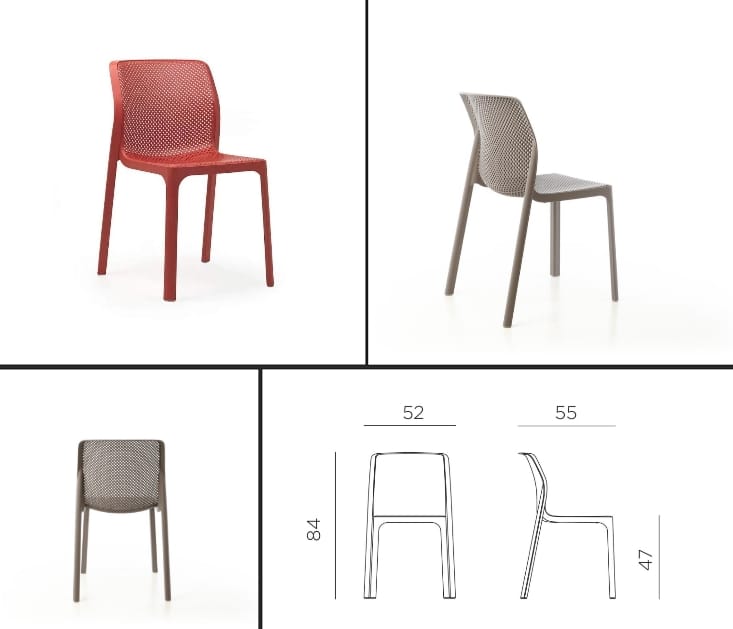
Multi-Angle Visual Reference
Comprehensive photographic coverage across front, lateral profile, rear, and top elevations. These angles allow the 3D modeler to cross-check curvatures, chair posture, leg tapers, and ergonomic proportioning from every view.
Blueprint & Dimensional Calibration
Official manufacturer dimensions and elevation blueprints sourced directly from the product page. These measurements calibrate the virtual viewport scale, ensuring millimeters-level accuracy before polygon modeling begins.
Modeling the Chair
We use 3DS Max for our 3D Modeling project. These are the steps we follow to make 3d model of the chair:
-
1. Creating a Basic Shapes:
The artist began by creating the basic shape of the chair. They started with a simple mesh and refined it to match the curves and contours of the real chair. Special attention was given to the unique pattern of the chair’s backrest and seat, which required careful manipulation of the mesh to replicate the intricate design.
-
2. Adding Details and Textures
Even though this particular chair did not require extensive texture and material work, once the basic shape was complete, the next step was to add details and textures to bring the chair to life. The artist used reference images to create realistic textures that mimicked the plastic material of the actual chair. They also added subtle details like seams and a slight sheen on the surface to enhance realism.
-
3. Lighting and Rendering
The basic lighting Rig was there in pre-built. The one that we use regularly for such cases. All it requires is to merge the chair 3D model into the light rig and hit the render button. However, this furniture model was created for interior 3D Rendering. We followed a detailed procedure as we needed the rendering to be photo-realistic.
Polygon Optimization and Material Realism
Polygon Optimization & Mesh Topology
Beginning with a simple base mesh, the artist iteratively subdivided and refined edge flow to match the organic curvature of the physical chair. Replicating the distinctive perforated punch pattern on the backrest and seat required rigorous quad-based topology control, eliminating non-manifold edges, vertex pinching, or shading distortion while maintaining a light polygon budget suitable for complex interior scenes.
Material Realism & Surface Nuances
While the Nardi BIT Chair features a streamlined monobloc plastic design without elaborate upholstery, achieving photorealism required nuanced PBR material calibration. Surface shaders mimic the subtle diffuse absorption of polypropylene, balanced with an authentic micro-sheen and fine mold parting seams to eliminate any artificial “CG plastic” appearance under variable lighting.
Conclusion
The creation of the Nardi BIT Chair 3D model was a pretty straightforward process. 7CGI team is creating such furniture models on a daily basis. To see more 3D modeling and rendering case studies from our projects, please follow the link.
From studying reference images to rendering the final product, each step required precision and an eye for detail. The result was a stunningly realistic Chair 3d model that could be used in various applications, from product visualization to virtual staging.
E-Commerce & Product Visualization
The high-fidelity 3D model delivers production-grade assets for furniture brand catalogs, digital marketing campaigns, interactive 360-degree configurators, and multi-angle e-commerce imagery without the overhead of physical photography setups.
Interior 3D Rendering & Virtual Staging
Engineered to drop seamlessly into pre-calibrated interior environments and studio lighting rigs for interior 3D Rendering, residential patio visualizations, commercial hospitality spaces, and real estate virtual staging.
Frequently Asked Questions
How do 3D artists create realistic furniture models from reference images?
The process begins by collecting high-quality images from multiple angles—including front, sides, back, and top—along with manufacturer blueprints and dimensions. The 3D artist uses these references as blueprint guides in software like 3ds Max, starting with a simple mesh and progressively refining curves, contours, and intricate geometric patterns.
What software is best suited for modeling furniture like the Nardi BIT Chair?
7CGI uses Autodesk 3ds Max for furniture 3D modeling projects. 3ds Max provides comprehensive polygon modeling tools, precise coordinate controls, and modifier stacks that make it ideal for manipulating complex curved surfaces and intricate backrest patterns.
How are textures and materials created to replicate plastic outdoor furniture?
Artists study real-life reference photos to develop realistic shader textures that emulate the plastic material. Subtle surface details such as parting seams, edge softness, and a calibrated surface sheen are incorporated to capture authentic specular highlights and avoid a flat, synthetic appearance.
How is the 3D chair model lit and rendered for interior design visualization?
The completed 3D chair model is merged into a pre-built studio lighting rig that 7CGI uses regularly. For photorealistic interior 3D Rendering, detailed lighting adjustments ensure accurate shadow falloff, global illumination, and material fidelity in residential and commercial settings.
Where can clients use photorealistic 3D furniture models?
Photorealistic furniture 3D models can be utilized across diverse applications, including e-commerce product visualization, interactive WebGL 3D configurators, virtual staging for real estate, and high-resolution architectural interior renderings.