
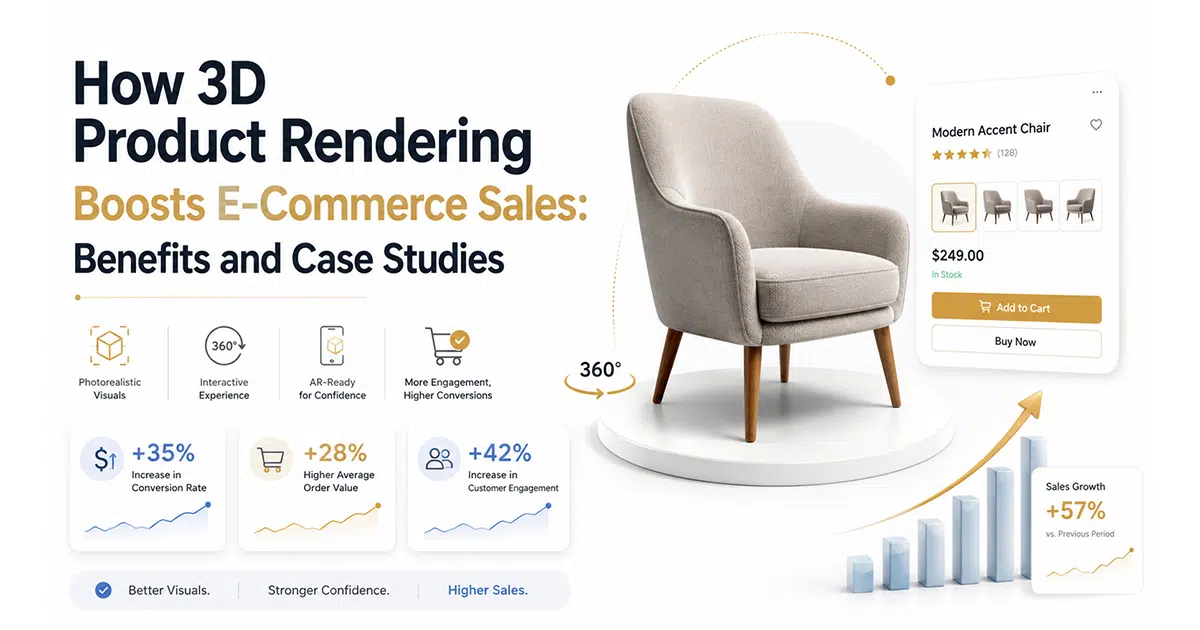
How 3D Product Rendering Boosts E-Commerce Sales: Benefits and Case Studies
A cross-brand guide examines product rendering, interactive viewers, and augmented reality through reported case studies, photography cost comparisons, platform requirements, and a practical investment framework.
Research & case studies
The Evidence Behind 3D Commerce
3D product rendering for e-commerce is the production of photorealistic product images, 360-degree views, interactive viewers, and AR-ready models from a digital 3D model instead of a physical photoshoot. According to Shopify platform data, merchants who add 3D content to product pages see an average 94% increase in conversions. Rebecca Minkoff reported that shoppers who used AR were 65% more likely to place an order.
This guide is written for e-commerce decision-makers evaluating whether to invest in 3D product rendering. It covers the consumer psychology behind the conversion lift, verified brand case studies across furniture, fashion, and consumer goods, a direct cost comparison with traditional photography, a platform-by-platform technical reference for Shopify, Amazon, Google, and Apple, and a decision framework for knowing when 3D rendering is worth the budget and when it is not.
Every statistic in this article is attributed to a primary source. Several widely repeated numbers in this space are recycled or misquoted, and we flag those explicitly so you can avoid using them in your own business case.
What Is 3D Product Rendering for E-Commerce?
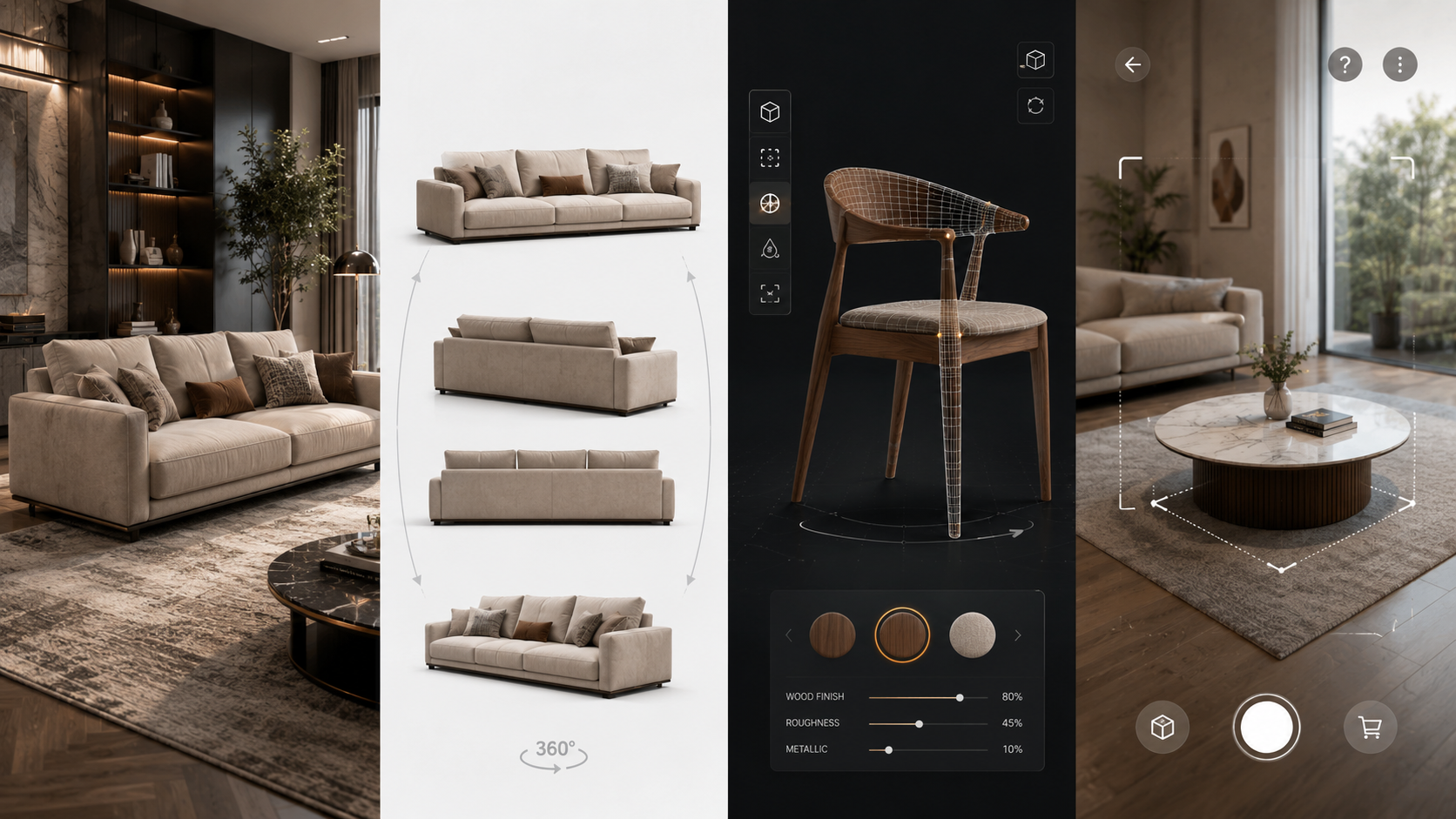
3D product rendering for e-commerce is the process of building a digital 3D model of a product and using that model to generate still images, 360-degree views, lifestyle scenes, and AR-ready files. One 3D model can produce dozens of outputs for Shopify, Amazon, Google Shopping, Apple Quick Look, and social channels without a physical photoshoot.
A 3D product render is created in software such as Blender, 3ds Max, Maya, or Cinema 4D, using physically based rendering (PBR) materials, HDRI lighting, and a rendering engine like V-Ray, Corona, or KeyShot. The artist builds a mathematically accurate digital replica of the product. Once that model exists, the brand can generate any number of outputs from it: white-background packshots, lifestyle room scenes, color and material variants, 360-spin sequences, animation, and the GLB and USDZ files required for augmented reality.
The economic model is different from photography. Photography is a repeated variable cost. Each new color, finish, packaging update, or seasonal scene needs a new shoot. 3D rendering is a front-loaded fixed cost. Once the base model is built, generating new variants and new scenes is relatively cheap and fast.
3D product rendering is not a replacement for all photography. It is a content production system that becomes cost-effective at scale and indispensable for products with many variants, spatial complexity, or pre-launch marketing needs. The categories where it delivers the strongest commercial results are furniture, home decor, fashion accessories, beauty, electronics, and any configurable product with multiple finishes or modular options.
Why E-Commerce 3D Product Rendering Works: The Consumer Psychology
3D product rendering increases conversions because it reduces the uncertainty buyers feel when they cannot physically inspect a product. Interactive 3D models and AR placement let shoppers verify size, scale, material, and fit before ordering, which directly addresses the perceived risk that drives cart abandonment and returns.
The Sensory Gap and Perceived Purchase Risk
Every online purchase is a decision made under uncertainty. The buyer cannot touch, hold, or test the product before committing. A 2024 systematic review published in the International Journal of Consumer Studies identifies perceived risk as the strongest negative predictor of online purchase intent. The three risk categories that block conversion most consistently are product risk, financial risk, and time risk. Product risk dominates in furniture, fashion, and home goods.
3D rendering attacks product risk directly. When a buyer can rotate a handbag to inspect the stitching, zoom into a sofa to examine the fabric weave, or project a desk into their actual office through AR to verify the dimensions, the specific uncertainty that was blocking the purchase is resolved.
The Endowment Effect and Psychological Ownership
The endowment effect is a cognitive bias documented by behavioral economists, including Nobel laureate Daniel Kahneman. People value objects they perceive as their own more highly than identical objects they do not own. In physical retail, this effect is triggered when a shopper handles a product. Online, static images fail to trigger it because the experience is passive.
Interactive 3D models change that. When a shopper configures a sofa by selecting a fabric, rotates a sneaker to a preferred angle, or places a coffee table in their living room through AR, the shopper has invested cognitive effort in personalizing the product. A 2023 study published in the Journal of the Academy of Marketing Science found that AR’s ability to superimpose products into a real-time environment increases personal relevance and mental simulation, which then increases desirability and purchase likelihood.
This is the mechanism behind one of the clearest pieces of public 3D commerce data. According to the Shopify Plus customer story for Rebecca Minkoff, shoppers who interacted with a 3D model were 27% more likely to place an order, and shoppers who used AR were 65% more likely to place an order. The lift increases with the depth of interaction, not just the quality of the image.
Cognitive Fluency and Reduced Decision Friction
A 2020 study in the Journal of Retailing and Consumer Services found that AR features, specifically environmental embedding and simulated physical control, reduce cognitive load and improve cognitive fluency. When product evaluation feels effortless, purchase decisions feel safer.
Photorealistic 3D rendering supports this through what researchers call haptic imagery. The brain processes detailed visual information about surface texture and material behavior as a partial substitute for physical touch. A render that accurately shows the grain of leather, the brushed finish of metal, or the weave of upholstery fabric gives the brain more decision-useful information than a flat photograph taken under flattering studio lighting.
Accenture’s immersive commerce survey reported that 47% of consumers said immersive technologies make them feel more connected to products, and three in five said they expect to buy more from brands that let them evaluate products this way.
Active Engagement and Dwell Time
Sayduck, the 3D visualization platform, reports that 82% of page visitors will engage with a 3D viewer when one is present, and 34% of users interact with the 3D asset for more than 30 seconds. Average active interaction time is approximately 20 seconds. Standard image carousels rarely hold attention for that long.
Extended engagement does two things. It deepens emotional connection with the product, moving the shopper further down the funnel. It also sends positive behavioral signals to search engines through longer session durations and lower bounce rates. Google has reported that 3D visuals achieve approximately 50% higher engagement than static images in search and display contexts.
Conversion Rate Data: What the Evidence Actually Shows
The evidence for 3D-driven conversion lift is consistent across academic studies, platform aggregates, and brand-level case studies. Shopify reports a 94% average lift across its merchant base. Brand-level case studies range from a 7% lift at CB2 to a 134% AOV lift at Gat Creek. The largest gains come from interactive features, not from replacing photos with static renders.
Platform-Level Benchmarks
According to Shopify’s own data, merchants who add 3D and AR content to product pages see a 94% higher conversion rate on average compared to products without 3D content. This figure is a platform-level aggregate, not a controlled experiment, and Shopify itself does not publish the methodology behind it. Treat it as a directional benchmark, not a guarantee.
Google reports that 3D visuals achieve around 50% higher engagement than static alternatives in its commerce surfaces. Google Merchant Center now supports 3D model links in glTF or GLB format for home goods and shoes in the US, Canada, Australia, Japan, and India.
Verified Brand-Level Case Studies
The strongest evidence comes from named brands that have published their own results. The case studies below are sourced directly from the brand, the e-commerce platform, or the technology partner that ran the implementation.
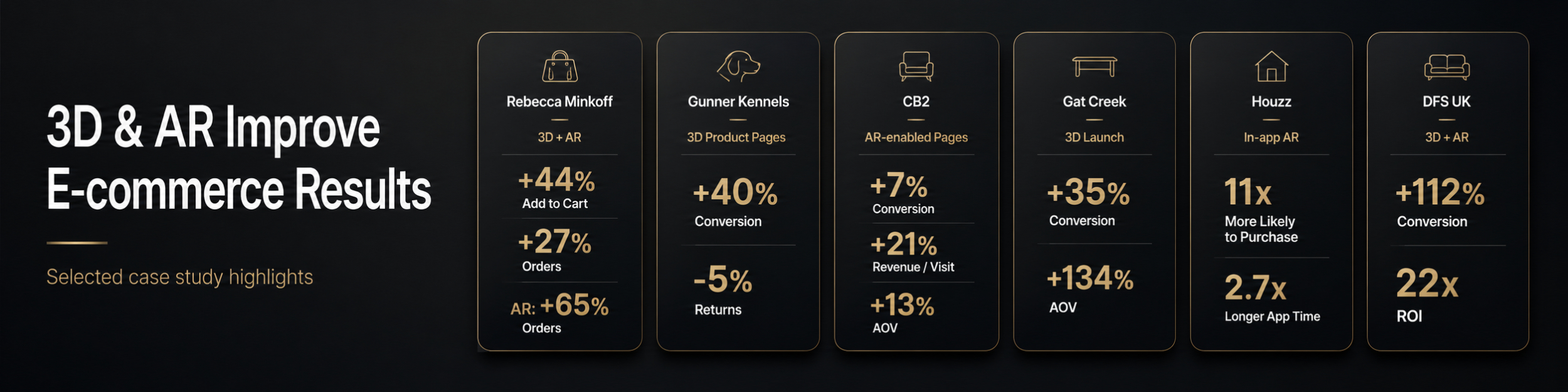
- Rebecca Minkoff (Shopify Plus + Modelry): Shoppers interacting with a 3D model were 44% more likely to add to cart and 27% more likely to place an order. AR users were 65% more likely to order. Source: Shopify Plus customer story.
- Gunner Kennels (Shopify Plus, 3D pages): 40% rise in order conversion and 5% reduction in returns. VP of Marketing Macey Benton attributed both to better size visualization. Source: Shopify Plus customer story.
- CB2 (AR via Vertebrae): 7% conversion lift, 21% increase in revenue per visit, and 13% AOV lift on AR-enabled pages. Source: Digital Commerce 360, October 2019.
- Gat Creek Furniture (Threekit): 35% conversion lift and 134% AOV increase within 7 weeks of launching 3D. Source: Threekit case study.
- Houzz (in-app AR room view): Users were 11x more likely to purchase and spent 2.7x longer in the app. Source: Houzz press release.
- DFS UK (3D + AR on 10,000+ variants): 112% conversion lift for 3D-enabled products and a reported 22x ROI on the deployment. Source: Enhance XR / DFS case study.
A 2019 study in the Journal of Retailing and Consumer Services tested 360-degree rotatable images against static 2D images across three experiments. Rotatable images produced higher purchase intention, with the largest effect in high-involvement categories where buyers needed to evaluate fit, proportion, or material. This supports the wider pattern: interaction matters more than image quality alone.
Statistics Often Misquoted in 3D Commerce Articles
Macy’s Return Rate: The widely repeated claim that Macy’s saw “25% fewer returns” from its VR pilot is incorrect. The primary Macy’s press release dated October 16, 2018 states that return rates dropped to less than 2% in VR-enabled stores. That is a stronger result, not a weaker one.
Nike Sales Lift: The “Nike +11% sales from AR try-ons” claim has no verifiable primary source. It appears only in secondary blogs and should not be used in a business case.
Tommy Hilfiger Cost Reduction: The “Tommy Hilfiger 70% content cost reduction” figure that circulates in 3D blog posts has no primary citation we have been able to trace. Use the documented “two weeks cut from design review” claim instead.
Shopify 94% Benchmark: The Shopify 94% conversion lift is a platform aggregate, not a controlled brand-level study. Use it as a directional ceiling, not as a guaranteed outcome for your category.
Return Rate Reduction: Often the Larger Financial Impact
3D and AR visualization reduce e-commerce returns because they close the gap between buyer expectation and delivered product. Shopify reports a 40% average return rate reduction for merchants using 3D. STAUD published a 66% return reduction for handbags and shoes versus 2D images. For brands with return rates above 20%, the savings often exceed the new revenue from conversion lift.
E-commerce returns represent approximately 10% of total supply chain costs, with rates exceeding 20% to 30% in apparel and furniture. Each return involves reverse logistics, warehouse inspection labor, repackaging, and inventory depreciation. The financial damage of a return is rarely just the lost sale.
The root cause of most returns is expectation mismatch. The product looks different from the photograph, does not fit the space, or does not match adjacent items in the home. Accurate 3D visualization and AR address these specific failure modes.
Verified Return-Rate Data
Shopify’s platform data shows that merchants deploying 3D visualization experience an average 40% reduction in product return rates. For spatial categories like furniture, AR-driven reductions tend to be higher.
STAUD, the fashion brand, reported through VNTANA that embedding 3D product viewers for handbags and shoes resulted in a 66% drop in returns compared to 2D product images. The verbatim figure appears on VNTANA’s case studies page, with STAUD as the named brand.
Gunner Kennels reported a 5% reduction in returns and exchanges after adding 3D models to product pages. The brand sells large-format pet kennels where size visualization is the primary purchase barrier.
In the furniture category, AR-enabled room visualization shows particularly strong return reduction. Industry data shows that AR consistently reduces returns classified as “too large or too small” by approximately 71% and returns based on color or style mismatch by approximately 58%. When a buyer has placed an accurate 3D model in their living room before ordering, the delivered product confirms their expectation rather than contradicting it.
What Most Ecommerce Teams Get Wrong About 3D ROI
Most internal business cases for 3D rendering focus only on conversion rate lift. That undercounts the return on investment by roughly half.
A typical ecommerce brand with a 25% return rate, $90 average order value, and 55% gross margin loses roughly $12 to $14 in margin per returned order once reverse logistics, repackaging, and inventory write-down are included. A 40% reduction in returns on 1,000 monthly orders saves $4,800 to $5,600 a month in margin protection alone.
On the same product, a 20% conversion lift on 20,000 PDP sessions at the same baseline assumptions adds roughly $4,950 a month in incremental margin.
Combined, that ecommerce brand sees closer to $10,000 a month in total margin improvement, not $5,000. The conservative model that ignores return savings frequently underestimates ROI by 50% or more.
Implication: Build your business case for 3D rendering on conversion lift alone so the numbers stay defensible, but track returns separately. The actual ROI in high-return categories is usually materially higher than the projection.
3D Rendering vs. Traditional Photography: Cost and Scalability
3D product rendering is not always cheaper than photography for a small product set. It becomes more economical at scale, typically once a product has five or more variants or needs frequent updates. According to a global study of more than 100 photo studios, 3D virtual photography costs approximately six times less than traditional photography for a 30-image, 5-product project.
The Direct Cost Comparison
Traditional product photography carries a fixed chain of physical costs: prototype manufacturing or sample shipping, studio rental, lighting and props, photographer and stylist fees, and post-production retouching. A global study of more than 100 photo studios across 17 cities in 11 countries found that producing 25 white-background silo images and 5 lifestyle scenes for 5 high-end products costs an average of $11,076. The same project costs $17,952 in New York, $15,322 in Los Angeles, and $15,023 in Copenhagen. Geographic cost variation in photography is extreme.
The same output produced through 3D rendering, including the same 25 silo images and 5 photorealistic lifestyle scenes, costs approximately $2,000 through a professional 3D studio, regardless of location. That represents roughly a six-times cost advantage at this project scope.
| Method | Avg. Cost (5 Products, 30 Images) | Geographic Volatility | Additional Requirements |
|---|---|---|---|
| Traditional Photography | $11,076 global avg ($17,952 in NYC) | Extreme | Studio, crew, props, sample shipping |
| 3D Product Rendering | Approximately $2,000 fixed | None | 2D references, dimensions, material notes |
The Cost Crossover Point
Photography is often cheaper than 3D for a single product with one finish and a few angles. The economics shift quickly when variant count, asset reuse, and update frequency are factored in. Industry practitioners consistently identify five to ten images per product as the crossover point where 3D reaches cost parity with photography and begins to outperform it on a per-image basis.
The advantage compounds beyond that point. Once a 3D base model exists, generating a new colorway, swapping a fabric, updating packaging artwork, or producing a new lifestyle scene requires only a materials change and a re-render. No new sample, no new shoot, no new studio booking. For brands with ten or more SKU variants, seasonal refreshes, or multi-market localization, the 3D cost advantage is structural rather than marginal.
IKEA has taken this to its logical conclusion. The company now generates approximately 75% to 90% of its product catalog imagery through CGI rather than physical photography. This gives IKEA consistent visuals across thousands of SKUs in dozens of regional markets without running a global photography logistics network.
A Simple ROI Framework
To estimate whether 3D rendering makes financial sense for your highest-traffic products, use this basic model:
Incremental monthly contribution = Monthly PDP sessions × Baseline conversion rate × Relative conversion lift × Average order value × Gross margin.
Applied to a product page with 20,000 monthly sessions, a 2.5% baseline conversion rate, $90 average order value, 55% gross margin, and a conservative 20% conversion lift, the incremental monthly contribution is approximately $4,950. A $20,000 3D project pays back in roughly four months under these assumptions. For high-traffic hero SKUs with 100,000 monthly sessions, the payback window shrinks to under two months.
This model excludes return-rate savings, which in high-return categories often match or exceed the conversion revenue benefit. A conservative business case that works on conversion lift alone is the most defensible starting point. If the project clears that bar without return savings, you have a strong case.
Case Studies: Real Brands, Real Results
The strongest evidence for 3D rendering ROI comes from named brands that have published their own results. Rebecca Minkoff, Gunner Kennels, CB2, Gat Creek, Macy’s, Adidas, and DFS have all reported measurable conversion lift, return reduction, or AOV growth tied to 3D and AR implementations.
Rebecca Minkoff: Fashion and Accessories
Rebecca Minkoff, working with Shopify Plus and 3D vendor Modelry, integrated photorealistic 3D viewers and AR into their product pages for luxury handbags. The implementation required building 3D digital models that accurately captured the leather texture, hardware sheen, and structural drape of each item.
According to the Shopify Plus customer story, shoppers who interacted with a 3D model were 44% more likely to add the item to cart and 27% more likely to place an order compared to shoppers viewing only static images. Shoppers who used AR were 65% more likely to order. Post-implementation analysis reported a 52% conversion rate increase and a 41.8% revenue per user increase among engaged shoppers.
Source: Shopify Plus customer story for Rebecca Minkoff; Modelry case study.
Gunner Kennels: Hard-Goods and Sizing Confidence
Gunner Kennels sells large-format pet kennels, a category where size visualization is the primary conversion barrier. After implementing 3D product pages on Shopify, the brand reported a 40% rise in order conversion and a 5% reduction in return and exchange rates. Macey Benton, VP of Marketing at Gunner Kennels, attributed both outcomes directly to 3D helping shoppers understand the physical scale of the product before ordering.
Source: Shopify Plus customer story for Gunner Kennels.
CB2: Furniture and AR Conversion
CB2, the contemporary furniture brand owned by Crate and Barrel, deployed web-based AR through Vertebrae, now part of Snap. According to a Digital Commerce 360 analysis published in October 2019, AR-enabled product pages produced a 7% conversion lift, a 21% increase in revenue per visit, and a 13% increase in average order value compared to non-AR pages. The data was attributed to David Widmer, Senior Director of Ecommerce at CB2.
Source: Digital Commerce 360, October 2019. Note: many secondary sources misattribute these numbers to Shopify. The correct attribution is Vertebrae as the AR technology partner.
Gat Creek Furniture: AOV and Speed to Results
Gat Creek, a mid-market American furniture brand, implemented 3D product visualization through Threekit. According to Threekit’s published case study, the brand reported a 35% conversion lift and a 134% increase in average order value within seven weeks of launch. The AOV growth is attributable to buyers gaining the confidence to select premium materials and configurations when they could see them rendered accurately before ordering.
Source: Threekit case study for Gat Creek.
Macy’s: Furniture VR Pilot
In 2018, Macy’s partnered with Marxent on a virtual reality furniture pilot deployed across multiple physical stores. According to a Macy’s press release dated October 16, 2018, the experience generated more than 60% larger basket sizes compared to non-VR furniture browsing, and the return rate for furniture purchased through the VR experience dropped to less than 2%.
This is an in-store VR pilot, not mobile AR, and the data is store-level rather than e-commerce-level. The frequently repeated 25% return reduction version of this statistic is incorrect. The primary press release clearly states less than 2%, which is a materially stronger outcome.
Source: Macy’s, Inc. press release, October 16, 2018.
Adidas: 3D Asset Scaling and Conversion
Adidas worked with VNTANA to digitize and scale 3D product assets across its footwear catalog. According to VNTANA’s published case study, Adidas generated 3D models of 2,500 shoes in approximately one hour using AI-assisted workflows, compared to six weeks using traditional modeling methods. Products with interactive 3D content showed more than double the conversion rate of products displayed only with 2D images.
Source: VNTANA case studies page.
DFS UK: Furniture and Full-Funnel ROI
DFS, the UK’s largest sofa retailer, digitized more than 10,000 product variants using 3D visualization and AR. Shoppers could view sofas in 3D, customize fabric and leg options, and project the configured product into their rooms. According to the Enhance XR case study, the implementation produced a 112% increase in conversion rates for 3D-enabled products, a 106% increase in revenue per visit, and an overall return on investment reported at 22 times the cost of the 3D and AR deployment infrastructure.
Source: Enhance XR / DFS case study.
See 3D Product Rendering Examples from 7CGI
If you are evaluating 3D product rendering for ecommerce, furniture, packaging, or industrial products, reviewing real studio output is the most useful starting point.
Visit the 7CGI Product Rendering Portfolio to see work across product categories, image types, and industries.
For a project scope review, send your product references, image requirements, and timeline. The team will respond with a clear quote.
AR Integration: When 3D Rendering Becomes More Powerful
A 3D product model is the foundational asset for augmented reality. Once a brand has accurate 3D models, the same files can power web product viewers, Shopify and Amazon AR features, Apple Quick Look, Google Shopping AR, and Meta or Snap AR ads. According to Houzz, AR users were 11 times more likely to purchase than non-AR users.
How AR Works with 3D Models
Augmented reality on mobile devices uses the device camera and, on newer iPhones and iPads, the LiDAR sensor to map the physical environment in real time. An accurate 3D product model is rendered at correct physical scale within that environment. On iOS, this experience is delivered through Apple Quick Look using a USDZ file. On Android and web browsers, it typically uses Google’s Scene Viewer and a GLB file. Shopify supports both formats natively and auto-optimizes models for global CDN delivery.
Web-based AR, often called WebAR, lets shoppers launch AR directly from a product page in a mobile browser without downloading an app. This removes the biggest historical friction barrier to AR adoption.
AR Conversion and Engagement Data
Houzz, the home design platform, reported that users who engaged with its in-app AR room view tool were 11 times more likely to purchase and spent 2.7 times longer in the app compared to non-AR users. The scale of this lift reflects the fundamental difference between imagining a product in your home and seeing it placed there.
Wayfair has built one of the largest proprietary 3D model libraries in furniture retail, with more than 18 million items processed through its internal 3D pipeline. According to Wayfair’s own reporting, customers who use AR features show materially higher engagement and purchase rates.
The augmented reality in e-commerce market is forecast to grow at a compound annual growth rate of 35.8% between 2025 and 2030. AR is no longer a future-state feature; it is a current commercial priority for any brand selling spatially complex or high-value products online.
Categories Where AR Delivers the Highest Returns
AR visualization produces the strongest results in product categories where buyers face high spatial uncertainty, high fit risk, or high tactile uncertainty:
- Furniture and home decor, where size, proportion, and room-context verification are the primary purchase barriers.
- Fashion accessories including bags, shoes, jewelry, eyewear, and hats, where try-on matters and photography cannot show proportionality against a body.
- Beauty and cosmetics, where virtual try-on for lipstick, foundation, and eyeshadow has measurable conversion impact.
- Electronics and appliances, where buyers need to verify fit, scale, and design compatibility with existing setups.
- High-consideration products priced above $200, where the financial risk of a wrong decision is significant enough to slow or stall the purchase.
Platform-Specific 3D Model Requirements: A Technical Reference
A single GLB master file with PBR materials and an exported USDZ for Apple covers Shopify, Amazon, Google Merchant Center, and Apple Quick Look from one source asset. Each platform has different polygon and texture limits. Amazon’s 20,000-triangle and 1024-pixel-texture caps are the strictest and should be planned for from the start.
Most existing articles on 3D product rendering do not give brands a usable cross-platform spec reference. The table below covers the major commerce surfaces where 3D product content is supported as of 2026.
| Platform | Preferred Format | File Size Target | Polygon Budget | Texture Size | Notes |
|---|---|---|---|---|---|
| Shopify | GLB + USDZ | Under 15 MB (ideally < 5 MB) | No hard cap (optimize) | PNG or JPG, PBR pipeline | OS 2.0 theme required; Shopify auto-optimizes for CDN |
| Amazon AR View | GLB binary | Under 5 MB | Under 20,000 triangles | Max 1024 × 1024 px | Brand Registry required; no animations; 2-week approval |
| Wayfair | Internal pipeline | Not supplier-uploaded | Managed by Wayfair | Managed internally | Wayfair models the catalog; uses ARKit and ARCore |
| Google Merchant | glTF or GLB | Under 10 MB rec (15 MB max) | Optimize for web | Max 2048 × 2048 px | Schema.org Product + 3DModel markup; US, CA, AU, JP, IN |
| Apple Quick Look | USDZ | 4 to 8 MB practical | Under 100,000 triangles | Under 4K (2K preferred) | Native AR in Safari since iOS 12; supports Apple Pay |
| TikTok Effect House | FBX or glTF for import | Effect-level constraints | Under 100 bones per model | Max 1024 × 1024 px | AR effects only; TikTok Shop does not accept GLB as product attribute |
The One Master Asset Approach
A single clean GLB master with PBR materials, correct physical scale where one unit equals one meter, and the pivot point at the floor covers Shopify, Amazon, and Google Merchant Center. Exporting a USDZ from the same source asset covers Apple Quick Look. This single workflow gives a brand AR-ready product pages across four major platforms from one production pass.
Amazon is the strictest platform. Models must stay under 20,000 triangles and textures under 1024 by 1024 pixels. This is a tight budget that requires deliberate mesh optimization. AI-generated 3D models often exceed these limits and need post-processing before they meet Amazon’s submission requirements. When briefing a 3D studio, specify Amazon AR compatibility as a requirement from the start so the production team builds the model within the constraints rather than rebuilding it later.
When 3D Product Rendering Is Not the Right Choice
3D product rendering does not deliver strong ROI for every product. It is the wrong choice for single-SKU brands with no variants, ultra-low-price commodity items, or product categories with technically difficult materials like complex fabric drape, food with steam, or transparent liquids. The strongest ROI comes from products with high uncertainty, many variants, or high return rates.
Most articles on 3D rendering do not address this question. The omission makes those articles less useful for budget-holders trying to decide where to invest. The honest answer is that 3D rendering is not the right tool for every product or every situation.
3D rendering delivers the strongest results when one or more of these conditions apply: high spatial or visual complexity, many color or material variants, a price point above $150 where purchase hesitation is significant, a category with frequent and costly returns, or a catalog that needs global localization and regular updates.
Specific product types where 3D rendering is technically difficult, expensive, or simply not worth the cost include:
- Soft or deformable materials such as complex textile drape, animal fur, human hair, food with steam or condensation, and liquids. These require simulation techniques that significantly increase production time and cost.
- Highly transparent or refractive materials such as crystal, fine glassware, or clear liquids. These are achievable but time-intensive. Budget for this specifically when briefing a studio.
- Very low-price, high-velocity commodity products. If a product sells for $5 and has no variants or spatial complexity, the ROI case for a $300 3D model is difficult to build.
- Single-SKU brands with no variants and no spatial uncertainty. If a product has no color options, no size variants, and no fit risk, standard photography may produce comparable results at lower cost.
Common Mistakes That Reduce 3D Rendering ROI
The technology is not enough on its own. The conversion benefit of 3D product rendering disappears when pages load slowly, when models are inaccurate, when brands publish 3D on low-traffic products first, or when the mobile experience is broken. Performance and accuracy matter as much as the asset itself.
Slow page loads: A high-quality 3D asset on a slow product page can produce no conversion lift or a negative one. Google reports that 53% of mobile visits are abandoned when load time exceeds three seconds, and a one-second delay can reduce conversions by up to 20%. Always test load speed on mobile after 3D implementation. Use compressed models, lazy loading, and poster states so the page renders immediately and the 3D viewer loads only when the user interacts.
Inaccurate 3D models: A 3D model that does not match the product’s actual dimensions, colors, or material behavior increases returns rather than reducing them. Define quality standards in the brief. Specify exact Pantone or hex color references, physical material samples, and accurate dimensions. Review the final model against the physical product before publishing.
Publishing 3D on the wrong products first: Launching 3D on low-traffic or low-margin products first makes it harder to measure ROI and build internal support. Start with high-traffic, high-margin, high-uncertainty SKUs. Measure the impact in a controlled way before rolling out across the catalog.
Ignoring the mobile experience: Approximately 78% of AR engagement happens on smartphones. A 3D implementation that works on desktop but breaks or loads slowly on mobile misses the majority of potential interaction. Test every implementation on mid-range Android devices, not just on the latest iPhone.
Treating 3D as a one-off campaign asset: The cost structure of 3D becomes favorable only when the master model is reused across multiple outputs: still renders, 360 views, AR files, variant swaps, seasonal scenes, and social assets. If a 3D model is produced for a single product page and then archived, the economics rarely justify the investment. Plan asset reuse before production begins.
How to Brief a 3D Rendering Studio: Files, Timelines, and Expectations
A clear brief reduces revision rounds and shortens delivery time. The minimum information a studio needs is product references from multiple angles, accurate dimensions, material notes, color codes, and a defined image set. Expect 1.5 to 3 weeks for a standard 8 to 10-image set with two revision rounds.
What to Provide in the Brief
- Product photographs from multiple angles, including front, back, top, bottom, sides, and close-ups of any material or texture detail.
- Accurate dimensions for width, height, depth, and any component measurements. CAD files, when available, eliminate dimensional ambiguity and reduce modeling time.
- Material notes covering specific material names, finishes, and reference codes. For furniture, fabric swatches or supplier material references are ideal.
- Color references in Pantone codes, hex values, or physical samples for every variant you need.
- A defined image set specifying exactly what outputs you need before modeling begins. White-background hero images, lifestyle scenes, 360-spin sequences, GLB files, and USDZ files all have different production requirements. Listing them upfront prevents scope changes mid-project.
- Platform requirements such as Amazon AR compatibility, Apple Quick Look support, or Shopify viewer integration. Specify these in the brief so the studio optimizes for the target platform from the start.
- Lifestyle scene references including mood board images, reference room photography, or brand-consistent interior references that define the desired environment and lighting direction.
Realistic Timelines
A standard 3D product rendering project for an e-commerce brand follows this general timeline, though complexity, revision scope, and studio capacity affect actual delivery:
- 3D modeling phase: 3 to 7 business days for a standard product. Complex mechanical components, intricate fabrics, or hardware take longer.
- Scene setup and initial rendering: 2 to 5 business days for lighting, materials, environment setup, and first-pass renders.
- Revision rounds: Most professional studios include two revision rounds in standard pricing. Budget time for feedback preparation and turnaround between rounds.
- Final delivery: GLB and USDZ exports, high-resolution still renders, and 360-spin sequences are delivered after final revision approval.
For a standard 8 to 10-image set covering one product and one lifestyle scene, total timeline from complete brief to final delivery is typically 1.5 to 3 weeks when working with an experienced studio.
What Is Changing in 3D Commerce in 2025 and 2026
Three shifts are reshaping 3D e-commerce in 2026: browsers are moving from WebGL to WebGPU for faster mobile 3D rendering, AI-assisted pipelines including 3D Gaussian Splatting are cutting asset creation costs by 60% to 80%, and spatial computing devices like Apple Vision Pro are pushing 3D assets from supplementary to primary in the shopping experience.
Browser Performance with WebGPU
The underlying technology for displaying 3D in web browsers is transitioning from WebGL to WebGPU, the W3C standard supported across Chrome, Edge, Safari, and Firefox. WebGPU communicates more directly with modern graphics hardware and introduces compute shaders, which enables complex real-time rendering on mid-range mobile devices that previously could not handle high-fidelity 3D viewers. Benchmark testing shows WebGPU handles large-scale matrix computations up to 3.5 times faster than WebGL. The practical result is faster, higher-quality 3D product pages on smartphones.
AI-Assisted 3D Asset Creation
Emerging techniques including 3D Gaussian Splatting let AI reconstruct a 3D model from a short video or photo set without manually building a polygon mesh. Production timelines using AI-assisted pipelines are being compressed by approximately 60%, and cost-per-asset reductions of 60% to 80% are being reported by early adopters. For brands with large catalogs, this is making 3D digitization of the full SKU range economically viable for the first time.
For e-commerce use cases that need strict platform optimization, particularly Amazon’s 20,000-triangle limit, AI-generated assets still require human post-processing. The technology reduces the cost of the initial model but does not yet eliminate the need for skilled human quality control.
Spatial Computing and Apple Vision Pro
Apple’s Vision Pro and competing spatial computing headsets represent the next layer of 3D commerce. Brands including e.l.f. Cosmetics, J.Crew, and Mytheresa launched spatial shopping experiences alongside the Vision Pro in early 2024. These experiences do not use 2D product pages. They place the user inside a 3D environment where products are browsed as volumetric objects.
The practical implication for e-commerce brands today is that the 3D models built for current product pages are the same foundational assets that will power spatial commerce as headset adoption grows. Brands investing in accurate, well-optimized 3D libraries now are building infrastructure for an environment where flat product images are supplementary rather than primary.
Frequently Asked Questions
How much does 3D product rendering cost per image?
A white-background silo image typically starts at $150. A photorealistic lifestyle scene with a full environment starts at $250 to $700. The initial 3D modeling of the product, which is a one-time cost that enables every future output, typically starts at $50 to $300 for standard consumer products and increases for complex mechanical or fabric-heavy items. For an accurate quote on your specific project, provide a studio with product references, dimensions, and a clear list of required image types.
For better understanding play with our pricing calculator.
Is 3D product rendering better than photography for ecommerce?
It depends on the product, the catalog size, and the variant complexity. Photography is often more cost-effective for a single product with one finish and no spatial complexity. 3D rendering becomes more economical at scale, typically once a product has five or more color or material variants, when the catalog needs frequent updates, when AR-ready assets are required, or when the product must appear in multiple environments. For brands with spatially complex products, high return rates, or large configurable catalogs, 3D rendering generally produces better long-term economics.
What files does a 3D rendering studio need to start a project?
The minimum set is product photographs from multiple angles, accurate dimensions, and material or finish references. CAD files reduce modeling time when available. For furniture and home goods, fabric swatches or supplier references help. For products that need Amazon AR compatibility, specify this in the brief so the studio optimizes the model for the platform’s polygon and texture limits from the start.
How long does a 3D product rendering project take?
A standard project for a single product with 8 to 10 images takes 1.5 to 3 weeks from a complete brief to final delivery, including two revision rounds. Complex products, large batches, animated sequences, or product configurators take longer. A studio will give a more accurate timeline once they have reviewed the references and image set requirements.
Which e-commerce platforms support 3D product pages?
Shopify natively supports GLB models for web 3D and USDZ for Apple AR on iOS, with automatic CDN optimization. Amazon supports GLB models for AR View and View in 3D through Brand Registry. Google Merchant Center supports glTF and GLB model links for 3D product experiences in Shopping results for home goods and shoes. Apple Quick Look works natively in Safari on iOS 12 and later using USDZ files. Wayfair manages its own 3D model pipeline for supplier products internally.
Does 3D rendering actually reduce product returns?
The evidence is consistent that accurate 3D visualization reduces returns, particularly in categories where buyer confusion about size, proportion, or material drives returns. Shopify reports an average 40% return reduction for merchants using 3D. STAUD published a 66% return reduction compared to 2D images for handbags and shoes. The strongest return reduction comes from AR visualization, where buyers can verify size and fit in their actual environment before ordering. The mechanism is straightforward: better pre-purchase clarity reduces post-purchase disappointment.
When should I not invest in 3D product rendering?
3D rendering delivers weak ROI for single-SKU products with no variants, very low-price commodity items where return rates are low and purchases are impulsive, and product types with extreme material simulation challenges such as complex drape, food, or transparent liquids. The clearest signal that 3D is worth investing in is a high return rate, a high variant count, or a category where buyers consistently ask spatial or sizing questions before ordering.
A Practical Decision Framework
3D product rendering is the right investment when your products have high uncertainty for buyers, many variants, high return rates, or a catalog that needs frequent updates. Start with two or three high-traffic, high-margin SKUs. Measure conversion lift and return rate separately. Expand only after the first results compound.
The evidence in this guide is consistent on one point: 3D product rendering and AR visualization deliver measurable commercial impact when they help buyers answer real purchase questions faster and with more confidence than 2D photography can. When they are interactive, mobile-optimized, accurate, and placed on the right products, they lift conversion, reduce returns, and improve brand perception. When they are slow, ornamental, or unnecessary, the lift narrows quickly.
For a brand evaluating whether to invest, the decision sequence is straightforward:
- Identify the two or three product pages where buyer uncertainty is highest.
- Build accurate 3D models of those products, prioritizing color and material accuracy.
- Deploy them with mobile performance as a hard constraint, not an afterthought.
- Measure conversion rate, add-to-cart rate, time on page, and return rate separately against a control group of unchanged product pages.
- Use the results to decide where to expand.
The brands that have already built this foundation, including Rebecca Minkoff, IKEA, Wayfair, CB2, DFS, and Adidas, are not investing in 3D as a campaign. They are investing in it as commerce infrastructure. The cost of building the same infrastructure has fallen significantly over the past two years and continues to fall. The question for most ecommerce brands is no longer whether to invest in 3D rendering. It is which product pages to start with.
Scale Your Catalog with Photorealistic 3D Renders
7CGI creates hyper-realistic 3D product renders, 360-degree views, lifestyle CGI scenes, AR-ready GLB and USDZ models, and product animations for ecommerce brands, furniture companies, industrial manufacturers, and packaging teams across North America and Western Europe.
Get a Clear Scope & Transparent Quote
To start a project, send product references, dimensions, material notes, and your required image types. Our studio team will review the scope and respond with a clear quote and timeline within one business day.
Explore all product rendering services
Discuss Your Project